
Coming Soon!!!
Saturday, July 9, 2011


Wednesday, July 6, 2011
The Amenbo Concept
The Amenbo Concept
Chk out the new innovative concept of using mouse.
http://www.techrefined.com/tech-news/amenbo-concept/
http://www.techrefined.com/tech-news/amenbo-concept/
Monday, February 28, 2011
Computer Memory Revolution
Volatile meet Non-Volatile
All of us have already heard about Volatile and non volatile memories.Now, think of a memory which is both and changes its characteristics with our needs.Yes, It is Possible now. Its done through a double floating point FET.
Look, we get it, you'll want RAM that behaves like flash, flash RAM that behaves like, and everything in between – high-speed computer memory that is not its data is lost when power is turned off, and lasts years succession.
Whereas the single floating-gate variety is currently responsible for the flash memory in your USB keys and SSDs, the second floating gate lets bits of data stay in an active, ready state, but the computer can also apply a higher voltage to "freeze" them in place. Since the memory can switch between static and dynamic modes in a single cycle and the data never disappears in between, researchers imagine the new tech could lead to instant-on computers and power-saving techniques that shut down idle memory banks.
All of us have already heard about Volatile and non volatile memories.Now, think of a memory which is both and changes its characteristics with our needs.Yes, It is Possible now. Its done through a double floating point FET.
Look, we get it, you'll want RAM that behaves like flash, flash RAM that behaves like, and everything in between – high-speed computer memory that is not its data is lost when power is turned off, and lasts years succession.
Whereas the single floating-gate variety is currently responsible for the flash memory in your USB keys and SSDs, the second floating gate lets bits of data stay in an active, ready state, but the computer can also apply a higher voltage to "freeze" them in place. Since the memory can switch between static and dynamic modes in a single cycle and the data never disappears in between, researchers imagine the new tech could lead to instant-on computers and power-saving techniques that shut down idle memory banks.
Tegra 3 coming soon -- a 1.5GHz quad-core mobile SOC
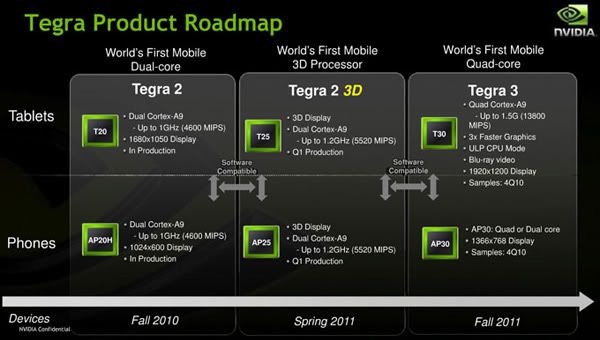
How aggressive can NVIDIA get? That's the question puzzling our brainboxes right now as we gaze upon the complete version of the slide that let us know about a potential Tegra 2 3D chip over the weekend. It's not every day you hear of a 1.5GHz quad-core mobile SOC, but our discovery of corroborating evidence for the T25 module sitting alongside it makes us more willing to credit the possibility of a Blu-ray-crunching, 13,800 MIPS-capable, multicore Cortex-A9 Tegra 3. Moreover, the roadmap of production samples in Q4 of 2010 fits perfectly with NVIDIA's claim that Tegra 3 was "almost done" in September of that year. The ULP designation on this listing stands for Ultra Low Power in NVIDIA parlance, which would indicate an aggressively tuned power management system -- the only way we can envision a quad-core anything operating within a tablet. Fall 2011 is when we should know for sure.
The latest iteration of the system-on-a-chip (SoC) is known internally at Nvidia as Kal-El. Samples of Tegra 3 are also thought to be shipping out already.
To demonstrate that Tegra 3 is a real product ready to go, demos were shown of the new chip running in a prototype Android tablet. The first demo sees a 2560 x 1440 stream decoded and played in real-time on the tablet and can be seen in the video above. A second demo aimed to show off the new 12-core GPU capabilities with 650 enemies running around in Great Battles Medieval without the hardware breaking a sweat. That same demo is seen stuttering on an equivalent Tegra 2 tablet.

Subscribe to:
Posts (Atom)